The Lemon Grove — Part One: Arrival
The Lemon Grove lives on the Library's Sacred Fiction shelf, the place in Maison Caché for stories that don't belong in the self-help section or the literary fiction aisle or anywhere a bookshop could shelve them without lying.
A woman answers a call she cannot explain. A house that was waiting for her. This is where it begins.
From the Old House — Sacred Fiction
Some stories arrive before you know you need them.
The Lemon Grove lives on the Library's Sacred Fiction shelf — the place in Maison Caché for stories that don't belong in the self-help section or the literary fiction aisle or anywhere a bookshop could shelve them without lying. They belong here. In the house. Where things are allowed to be what they are.
This is the first chapter. It begins where all the real ones do: with a woman who answers a call she cannot explain, and a house that was waiting for her.
Parts Two through Five are available in The Inner House. One per day, Monday through Thursday, until the cycle closes.
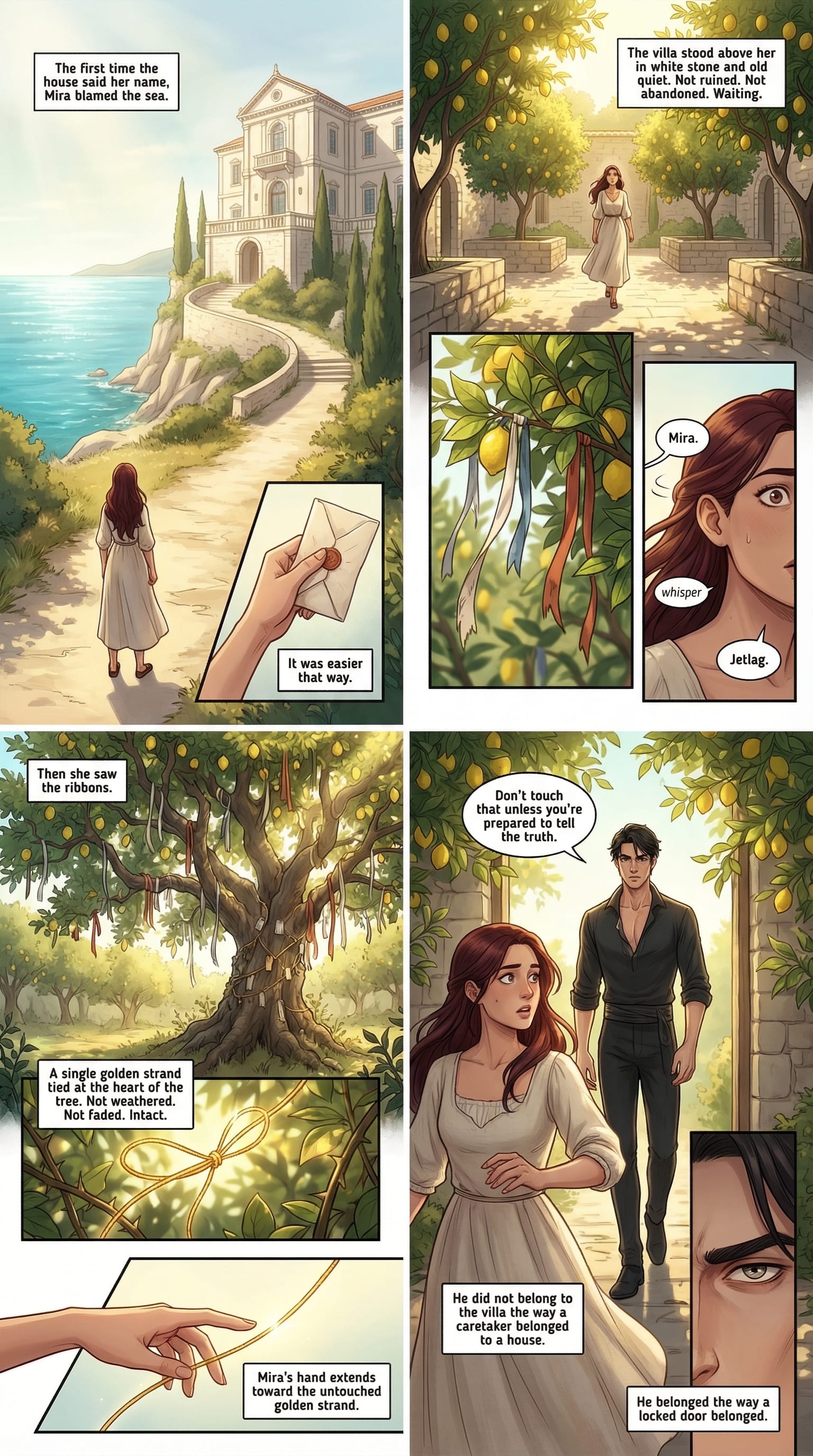
The first time the house said her name, Mira blamed the sea.
It was easier that way.
The road had wound itself along the cliff for so long that by the time she stepped out of the hired car, her body no longer trusted stillness. Heat clung to her skin. Salt sat on the air like breath held too long. Below, the sea flashed hard and bright against the rocks, all silver violence and false innocence, as though it had never swallowed anything whole in its life.
The villa stood above her in white stone and old quiet.
Not ruined. Not abandoned. Waiting.
Mira closed the car door and looked up at it with the strange, immediate certainty that she had arrived somewhere she was expected, though no one stood in the doorway. No servant. No host. No cheerful explanation waiting to dissolve the unease. Just open shutters, a terrace washed in afternoon gold, and the kind of silence that did not feel empty so much as attentive.
In her hand was the letter.
The paper had softened at the folds from how often she had opened it on the flight, in the taxi, at the hotel the night before when sleep refused to come. Even now she could have recited the final line from memory.
Come if you still wish to know what was left for you.
No signature. No explanation. Just the villa's name beneath it, written in a hand that was almost elegant enough to make the command feel like an invitation.
Almost.
She should have laughed, weeks ago, when it first arrived among bills and catalogues and the usual dead paper of ordinary life. Should have dropped it in the bin and gone on being sensible. Instead she had booked the ticket the same night, furious at herself for wanting answers to questions she could not even name.
That was Mira's curse, if she had one. Not curiosity exactly.
Recognition.
The feeling that when something called to her in the right voice, some buried and unruly part of her always answered.
The path from the gate curved through low stone walls and overgrown rosemary. Lemon trees crowded one side of the courtyard, their leaves dark and glossy under the sun, fruit hanging heavy like lanterns. The scent hit her before the beauty did — sharp, clean, almost sweet enough to hurt. And beneath it, something older. Dust warmed by light. Crushed leaves. A trace of wax or smoke, like someone somewhere in the house had lit a candle and forgotten to blow it out.
Mira took another step.
Then another.
Halfway to the terrace, the wind changed.
It did not rise. It narrowed.
A single thread of cool air moved across the back of her neck and slipped against her ear with the intimacy of a mouth.
"Mira."
She stopped dead.
The sea threw itself lazily against the cliffs below. A shutter tapped once somewhere above her. Nothing else moved.
Her pulse turned sudden and foolish in her throat.
She looked over her shoulder, annoyed already at the stupid leap of adrenaline, at the primitive part of her body that always reacted first and reasoned later. There was no one behind her. No one at the gate. No one on the path.
Just sunlight. Stone. The lemon trees.
"Jetlag," she muttered.
The word fell flat.
Then she saw the ribbons.
They hung from the oldest tree in the grove, half-hidden among the leaves — dozens of them, maybe more, faded and frayed and tied so carefully that they made her chest tighten before her mind caught up. White once, some of them. Blue. Crimson worn rust-dark by weather and time. Each strip of fabric looped and knotted with deliberate hands, as though every ribbon marked a promise someone had been desperate enough to make visible.
The grove shifted in the wind.
No — that was not right.
The ribbons shifted.
The trees themselves felt still. Listening.
Mira stepped off the path before she could tell herself not to.
Up close, the little knots were even stranger. Some were clean and neat, pulled tight with ceremonial care. Others looked hurried, trembling, half-wild, as though whoever tied them had done so with tears in their mouth or terror in their hands. One ribbon had words written on it, but the ink had bled into a bruise of unreadable blue.
She reached toward a pale strip caught low on the branch.
It wasn't the ribbon that stopped her.
It was the glint.
Something finer than silk caught in the leaves deeper in, hidden among thorn and shadow. Gold. Not bright and gaudy, but warm and unmistakable, like sun trapped in thread. It flashed once when she moved, then disappeared again.
Mira leaned in.
There it was.
A single golden strand tied at the heart of the tree.
Not weathered like the others. Not faded. Intact.
Her hand lifted without permission.
Of course it did.
That was the point, wasn't it? The whole shape of her life in one small, humiliating movement: something beautiful and forbidden gleaming just out of reach, and Mira stepping toward it like she had never once learned the difference between invitation and warning.
Her fingertips were a breath from the branch when a voice behind her said,
"Don't touch that unless you're prepared to tell the truth."
She turned too fast.
The man standing at the edge of the grove did not look startled to find her there. If anything, he looked as though he had arrived at the exact moment he intended to. Dark clothes, open throat, sleeves rolled once as if precision mattered even in heat. He was not smiling. Not unfriendly, either. Just still in that unnerving way some people were still — like a blade laid flat on a table.
His gaze flicked to her hand, then to the gold thread at the center of the branches.
"You heard me," he said.
Mira lowered her arm slowly, more because she disliked being caught than because she had decided to obey. "That depends."
"On what?"
"On whether this is the part where you explain why your garden talks."
For the first time, something almost like amusement moved in his face. Not warmth. Not softness. Just a brief shift, quickly buried.
"My garden doesn't talk."
"No?" she said. "Then someone here knows my name."
His eyes settled on her fully then, and she felt it like a hand at the nape of her neck.
Not desire. Not yet.
Recognition.
A quieter, more dangerous thing.
The man stepped into the light beneath the lemon leaves, and Mira understood with abrupt, ridiculous clarity that he did not belong to the villa the way a caretaker belonged to a house.
He belonged the way a locked door belonged.
The way a rule belonged.
The way consequence belonged.
"Then the house has decided not to waste time with you," he said.
Part Two continues in The Inner House. Mira has arrived. The house has already made its decision. Vale hasn't introduced himself yet — not properly. That happens in the dark, at the grove's edge, in the second part.
Want part two? Sign up for The Grimoire